Camunda 7 vs. Camunda 8 in 2026: migration, risks, and alternatives for financial services
In 2026, organizations using Camunda 7 are already seeing the impact of the end of support for the Community Edition: no security patches, no updates, and the need to maintain the environment and ensure its stability on their own. For banks, insurers, and other companies operating in regulated environments, this means making a decision about the future direction of the platform while factoring in maintenance costs, operational risk, and the impact of changes on existing processes and integrations. The choice comes down to assessing whether the organization is ready to migrate to Camunda 8 or needs a solution that preserves greater continuity with its current architecture.
What should you know?
- Do you just want to “update Camunda”? Migrating to Camunda 8 may mean changing the architecture, not simply upgrading the BPMN engine.
- Do you have many existing processes and integrations? Start by assessing the scope of the rebuild: integrations, transaction handling, error handling, the data model, process logic, and the cost of maintaining production operations.
- Are you building a new cloud-native environment? Camunda 8 can be a strong fit for distributed architecture, scalability, and component separation.
- Do you run critical processes in a regulated environment? Compare a full migration with an evolutionary path that may better protect business continuity.
Why does migrating from Camunda 7 to Camunda 8 mean changing the architecture?
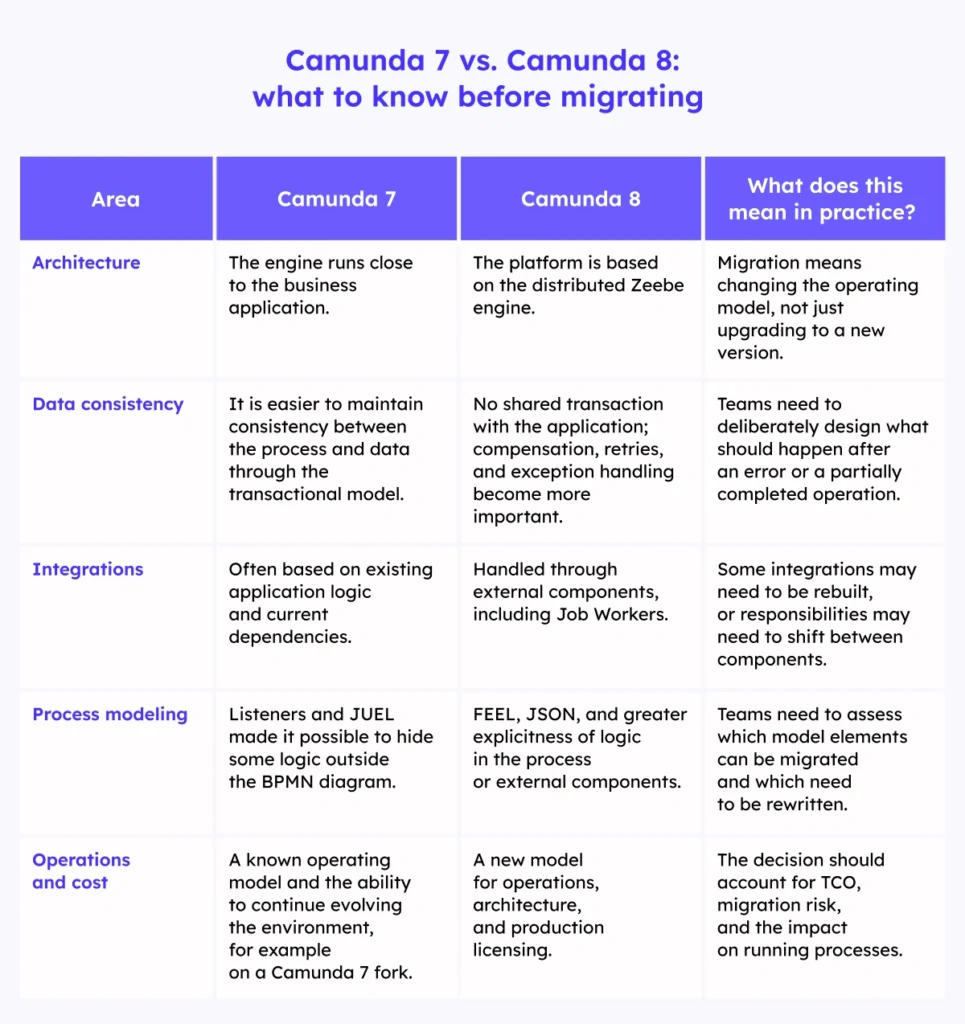
Migrating from Camunda 7 to Camunda 8 is not simply a matter of moving processes to a newer version of the engine. It changes how the platform stores process state, communicates with external systems, and handles errors during case execution. As a result, an organization that has spent years developing processes in Camunda 7 must validate the actual scope of the migration: what can be moved with limited changes, what will need to be rebuilt, and how the cost of maintaining the environment will change after moving to the new platform.
To better assess the scale of this change, it is worth looking at what defined Camunda 7: its strengths, its limitations, and the architectural assumptions that shaped how processes were designed over the years.
Camunda 7: process and data consistency in financial systems
Camunda 7 is based on an embedded model, where the process engine runs close to the business application and its logic. This made it easier to design processes in which case progression, the data written to the system, and error handling remained consistent with one another. Technically, this was supported by shared ACID transactionality, which made it possible, within certain boundaries, to roll back both the business logic and the process state recorded by the BPMN engine.
For financial services, this was an important advantage of the Camunda 7 architecture. In processes that require auditability, control over case status, and predictable error handling, this model reduced the risk of situations where the process shows one thing while the data stored in the system shows something entirely different.
Camunda 7: flexible modeling and scaling limitations
In Camunda 7, listeners and JUEL helped keep BPMN models readable, even when processes included complex technical logic. Some of that logic could be moved outside the diagram, such as reactions to process events, selected conditions, or calls to application logic. As a result, models remained understandable for analysts, architects, and business stakeholders, while technical teams retained the flexibility needed to integrate with the application and external systems.
This architecture, however, also had its limitations. Camunda 7 relies on a relational database as the central mechanism for storing process state, engine tasks, and historical data. With a large number of instances, heavy write activity, or high concurrency, the database can become a bottleneck for the entire solution.
The need for better scalability, especially in distributed and cloud-native environments, was one of the reasons Camunda 8 was built on a different architectural model.
When does the Camunda 8 architecture deliver the most value?
Camunda 8 is best suited to environments designed from the ground up for microservices, horizontal scaling, and a cloud-native model. Its engine, Zeebe, uses event streaming instead of a relational database as the central mechanism for storing process state. This allows it to better support distributed architectures, but it also requires a different approach to designing integrations and maintaining processes.
The way business logic is executed also changes. In Camunda 8, it runs outside the process engine, through external components called Job Workers, which communicate with the platform over gRPC. This makes scaling and separation of responsibilities easier, but it requires a different approach to integration, error handling, and process operations.
Camunda 8: data consistency and error handling
In Camunda 8, the process engine and business logic no longer run within a single shared ACID transaction. As a result, an error in one component does not trigger a simple rollback that simultaneously reverses both the process state and the data written to the business system.
The organization moves to an eventual consistency model. It must clearly define what happens after an error, a communication failure, or a partially completed operation. In practice, this means explicit management of process consistency, including compensation mechanisms where the effects of completed actions need to be reversed or reconciled. Exception scenarios, regression testing, and monitoring also become more important, because process consistency no longer comes from a single shared transactional mechanism.
For financial services, this is especially important because a process cannot merely “execute successfully” from a technical standpoint. It must leave behind consistent data, decisions, and an audit trail that can be explained even when an error, retry, or communication interruption occurs along the way.
Camunda 8: data, FEEL, and more explicit BPMN models
Another change involves how teams work with data and logic in processes. In Camunda 8, process variables are based on JSON values, and FEEL is used instead of JUEL, which was familiar from Camunda 7. For teams, this changes how conditions, decisions, and data flows are expressed within the process.
The role of mechanisms that, in Camunda 7, allowed some technical logic to be hidden outside the BPMN diagram also changes. When migrating to Camunda 8, these elements cannot always be moved directly; some need to be rewritten, moved into external components, or modeled more explicitly in the process.
This can make models more transparent, but it requires greater discipline in BPMN design, especially where a significant amount of logic was previously “hidden” in code.
How does Camunda 8’s licensing model affect maintenance costs?
From a production standpoint, the licensing model is also an important part of the decision. Under the current model for Camunda 8 Self-Managed, free use primarily applies to development and testing environments, while production use requires an Enterprise license. For organizations, this means the cost of migration does not end with the implementation project itself. The license becomes an ongoing part of the operating model and should be included when assessing the platform’s total cost of ownership.
Migration to Camunda 8 should therefore be evaluated as more than a technology change. It affects the data model, integration approach, error handling, process consistency management, and the cost of maintaining the environment in the years ahead. Before making a decision, organizations should weigh the benefits of the new architecture against the scope of the rebuild required for the existing environment.
When should you consider a Camunda 7 fork instead of migrating to Camunda 8?
An alternative to migrating to Camunda 8 is an evolutionary approach based on continued development of an architecture compatible with Camunda 7. One example of this direction is platforms based on a Camunda 7 fork, such as Altkom Software BPMS, which allow organizations to preserve compatibility with existing BPMN processes, business logic, and the current integration model.
For organizations, this creates an opportunity to limit the scope of change while still securing support, security updates, and continued platform development. It delivers the greatest value where many processes, integrations, and dependencies have been built around Camunda 7 over the years and would be difficult to migrate quickly.
This does not mean there is no work required on the organization’s side, but it can help avoid a full architectural transformation and keep the focus on stable operations and the gradual evolution of the process environment.

How to decide: migrate to Camunda 8 or take an evolutionary path?
The decision should be driven not only by the technology roadmap, but also by the current state of existing processes, integrations, and production dependencies. Camunda 8 will be the better choice when the goal is to build a new, scalable process platform in a distributed, microservices-based, cloud-native environment. An evolutionary path will be more justified when the priority is to maintain continuity for existing processes, limit the scope of change, and reduce risk to integrations that already support critical business operations.
As this shows, the BPMS platform decision in 2026 is not just about the tool itself. It is a decision about how the organization manages risk, operating costs, and the pace of process transformation — in areas that often have a direct impact on business continuity.