From AI experiments to real processes: what MCP can offer insurers
A new phase in thinking about AI is beginning in insurance. Not as a standalone tool for experiments, but as an element meant to work alongside the processes, data, and systems used every day. This shifts the focus away from the models themselves and toward how they are embedded in the organization, and MCP is one approach to addressing the challenges of the next stage of digital transformation.
What’s worth knowing:
- MCP doesn’t replace core systems. It lets you use them differently, creating a shared access layer for data and operations that AI can work with — without the cost of replacing your existing environment.
- In many organizations, the bottleneck today isn’t the models — it’s integration. In insurance, how AI connects with policies, claims, and customer service is usually what determines whether a deployment can realistically scale.
- AI can enter the process, but not without guardrails. MCP opens a path to embedding AI in real operational workflows, provided the organization clearly defines the boundaries of automation, oversight, and accountability.
Why MCP is starting to matter
The insurance sector is feeling the gap between the pace of business change and the capabilities of the systems that underpin its core processes. This is especially visible in areas like policy administration, claims handling, customer contact, and partner collaboration — because that’s precisely where rising expectations around speed, quality, and service consistency most often run into architecture that has been built up over years, system by system.
The result is fairly predictable: in the areas where organizations see the greatest potential for automation and AI, implementing change frequently stalls on integrations, core system limitations, and the cost of adapting an existing environment to a new way of working.
At the same time, AI capabilities are maturing faster than organizations can put them to practical use. Generative models and AI agents can now do more than analyze information — they can support real operational actions. And that’s exactly where MCP starts to matter, by addressing a specific problem: how to connect new AI capabilities with an insurer’s existing environment without costly replacement of critical systems.

What MCP actually is
At its simplest, MCP is an open communication standard proposed by Anthropic for connecting AI models with the systems, data, and services an organization uses.
In practice, this means that instead of building separate integrations for every model, tool, and process, organizations can establish a structured middleware layer through which AI accesses the functions and information it needs in a controlled, predictable, and secure way.
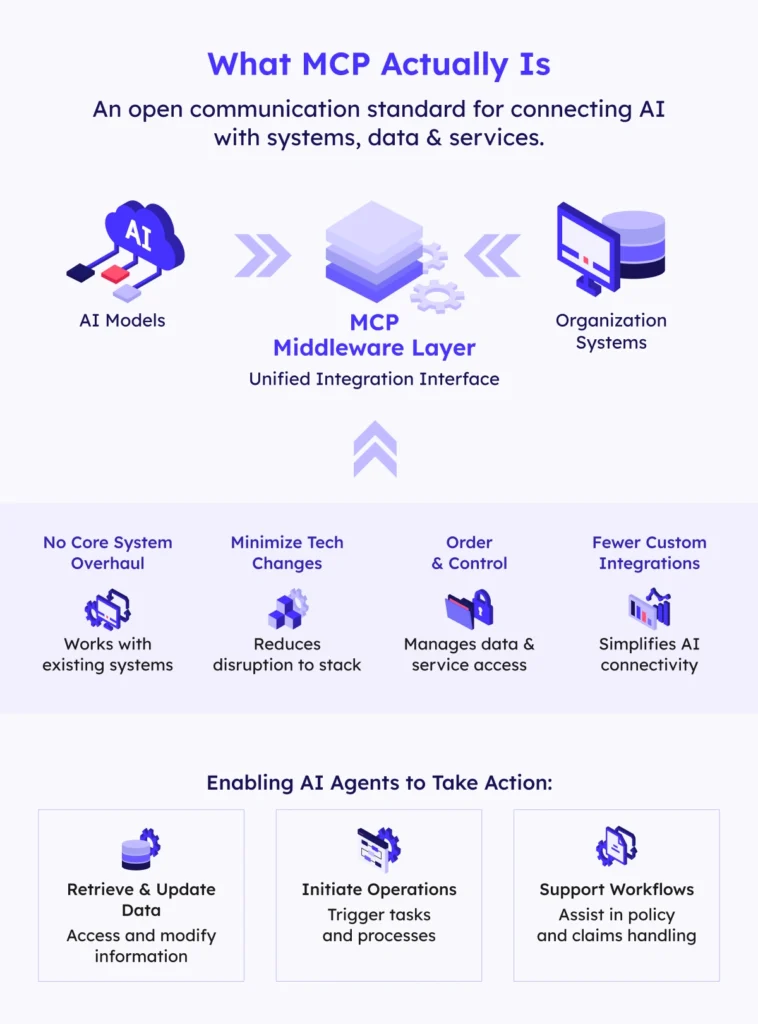
From a business perspective, MCP works as a shared integration layer for AI — one that:
- doesn’t require replacing or rebuilding core systems,
- minimizes changes to the existing technology stack,
- brings order to how models use data and services,
- reduces the number of custom integrations built separately for each use case.
This matters because it means AI no longer has to be limited to retrieving information, suggesting next steps, or generating content. It can also perform specific actions within systems — retrieving data, initiating selected operations, or supporting process execution within the boundaries defined by the organization and user permissions.
That’s why MCP is becoming an important enabler of AI agent-based approaches in insurance: solutions that don’t just support employees with recommendations, but can actively participate in handling policy, post-sale, and claims processes.
Why MCP matters for insurance
The insurance industry is technologically complex and has been grappling with significant technical debt for years. Policy, claims, and billing systems were often built decades ago, which means any major change today carries high cost, risk, and implementation complexity.
No core replacement required
MCP doesn’t replace existing systems — it helps organizations get more out of them.
Instead of building yet more integrations, custom APIs, and separate connectors for different models, it introduces a single layer that brings order to data and operations access and makes it easier to deploy AI in practical applications.
Easier scaling
MCP creates a consistent way to connect AI with data and operations, so subsequent deployments don’t have to start from scratch with a new integration every time. If the approach proves effective in one process, it’s easier to extend to other areas — from policy administration and claims to underwriting, customer contact, and post-sale processes.
Faster implementation of changes
When AI access to systems and operations is organized within a single layer, it’s easier to develop additional parts of a process without rebuilding everything from the ground up. In practice, this can shorten the path to changes in workflows, business rules, and handling of new scenarios.
Early results from the market
Initial deployments show that MCP is no longer just a technical concept. According to a 2025 announcement from Sure, ¹ pilot tests achieved process time reductions of several tens of percent in some cases, with individual instances reporting figures exceeding 90%. While the absence of detailed comparative data means these results can’t be treated as representative of the industry as a whole, they are a signal that AI can support not just information analysis, but actual insurance process handling.
MCP as a security and control layer
In a regulated industry, what matters isn’t just whether AI can be connected to a process — it’s the terms on which it will operate. MCP helps bring order to this, giving organizations greater control over how models use data and systems.
- Permissions — it’s easier to define what data and operations AI can access.
- Scope of action — the model operates within clearly defined boundaries rather than being granted broad system access.
- Audit trail — it’s easier to log what was performed by AI and at which point in the process.
- Human role — automated actions can be clearly separated from those requiring human approval.
- Incremental deployment — additional use cases can be developed without touching core systems.
For an insurer, this means being able to use AI not just in data analysis, but directly within processes — without giving up control over access, operations, and accountability.
New business opportunities with MCP
MCP is one of the approaches opening the door to use cases that were previously difficult to implement without costly intervention in core systems.
Policy and claims processes
In these areas, AI can take over a portion of repetitive tasks and better support day-to-day process handling:
- quote preparation and pricing,
- policy changes and endorsements,
- post-sale servicing,
- claims registration and updates.
One layer across multiple systems
For companies operating across several different systems, MCP can serve as a shared layer that brings order to how AI is used:
- consistent AI use across multiple environments,
- process standardization,
- fewer duplicated integrations.
Partner and agent servicing
This approach also offers greater flexibility in working with partners, brokers, and agents:
- automation of selected tasks,
- simpler capability sharing with partners,
- test environments for new products.
Will MCP solve every problem?
It’s worth saying this plainly: MCP is not a solution to every legacy system problem. It has its limits and won’t replace the work an organization still needs to do on its own side.
It won’t fix:
- data quality issues and data model problems,
- poorly designed APIs,
- transactional limitations of the systems AI is meant to integrate with,
- inconsistent business processes.
MCP doesn’t eliminate the root causes of these problems, but it can help organizations approach modernization differently. Rather than one large, high-risk overhaul, it allows for incremental improvements — where and when the organization is ready for them.
A use case: registering a property claim without switching between systems
The challenge
In property claims handling, employees typically work across several systems at once. They check customer data and contact history in the CRM, verify coverage and policy status in the policy system, and then open a case in the claims system — re-entering much of the same information all over again.
On top of that, there’s the analysis of documents, photos, invoices, and reports. Some data has to be copied or filled in across multiple places. The result: the process takes longer, the risk of errors and inconsistencies grows, and the customer waits longer for a meaningful update.
What this could look like with MCP
In this scenario, an AI agent acts as a process coordinator. It has controlled access to the data it needs and can perform selected actions on behalf of the employee.
Consolidating context
The agent pulls together the key information from the CRM and policy system in one place: customer data, contact history, policy status, coverage scope, limits, and exclusions.
Analyzing the claim and documents
Based on the claim description and attachments, it extracts the key information, flags missing items, and highlights elements that require human attention.
Opening the case and saving data
Instead of manual re-entry, the agent creates the claim record in the claims system and transfers the agreed data from other sources — contact details, policy ID, event description — directly into it.
Preparing next steps
If documents or additional information are missing, the agent compiles a list of gaps, drafts a message to the customer, and saves a summary in the CRM so the entire team has a consistent view of the case.
Outcomes
- less manual work and fewer data entry errors,
- faster case preparation ahead of the first decision,
- more consistent customer communication,
- easier replication of the approach across other processes.
The limits of automation
This approach doesn’t mean the AI agent operates independently in every situation. The organization must define which actions can be automated and which still require human involvement.
This applies above all to financial decisions, denials, process exceptions, and cases where gaps or ambiguities arise. In those situations, the agent can prepare the data, organize the case, and speed up the work — but it shouldn’t take full responsibility for the decision.
Why it’s worth thinking about MCP now
For insurers, this is an important moment — not because MCP “solves everything,” but because it may help organizations avoid entering the next phase of digitization with the same problem they’ve had before: multiple point-to-point connections that are hard to scale, maintain, and build on. The more processes AI is expected to support, the more a shared layer for data and operations access matters — rather than another set of integrations built separately, one by one.