
How to assess data maturity in a leasing company: six dimensions of evaluation
Leasing companies have more and more data, reports, and BI tools, but they often lack a shared view of the customer, lease contract, risk, and portfolio. When teams work from different data definitions, decisions slow down, IT takes on the burden of reporting, and analytics and AI become difficult to scale. That is why this article presents six dimensions for assessing data maturity. They help bring structure to this area by identifying strengths, gaps, and priorities before the organization makes further investments in analytics and AI.

Key takeaways:
- Data maturity is not determined by the number of reports or by the BI platform a company uses. What matters is whether the company has shared data definitions, clear owners, quality controls, and access rules.
- One weak area can block the others: without governance, trust in reports declines; without a sound architecture, analytics is difficult to develop; and without adoption, the business does not use the solutions already available.
- A six-dimensional assessment covers: technology, data governance practices, data quality and availability, people’s skills, the use of AI, and the business impact of data.
Data maturity assessment model tailored to leasing
To help leasing companies assess data maturity and plan the development of analytics and AI, we created the Leasing Data Maturity Model (LDMM) — our proprietary assessment model tailored to the realities of the leasing sector.
The model describes an organization’s development path from fragmented, reactive work with data to advanced use of analytics, AI, and data monetization. We discussed the maturity levels, their characteristics, and their importance in more detail in the previous article:

In this article, we explain what the dimensions of data maturity assessment are. While maturity levels show the organization’s overall stage of development, the dimensions allow for a deeper view: they show where the company has strong foundations, where gaps appear, and what should be addressed first.
Six dimensions for assessing data maturity in a leasing company
In the Leasing Data Maturity Model, we analyze six dimensions that together describe a leasing company’s readiness to work with data:
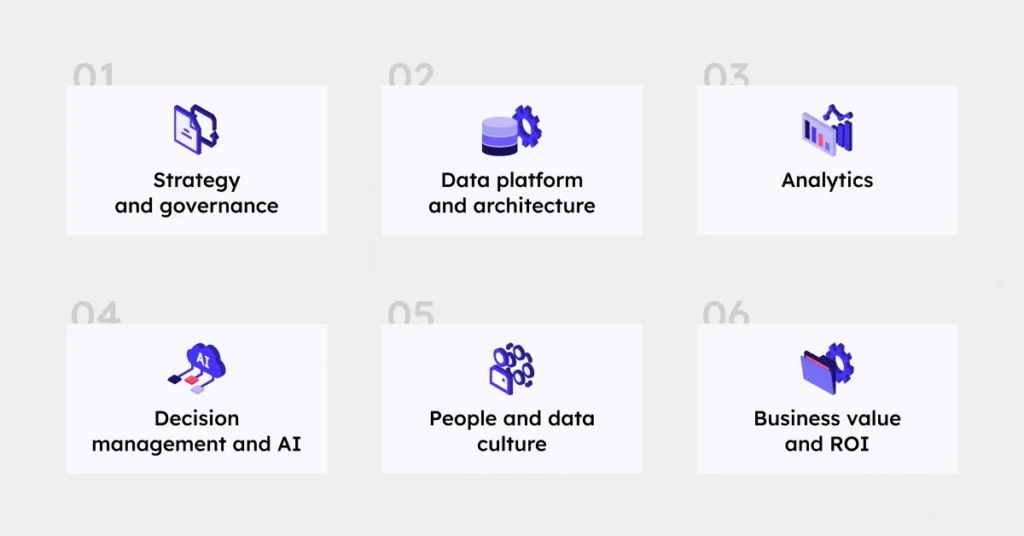
1. Strategy and governance: are there clear data owners and shared rules?
The first dimension shows whether the company manages data as a business asset, not only as a technical asset. We assess whether the data strategy supports the organization’s goals, whether key domains have owners, and whether shared definitions exist for the most important concepts and KPIs.
In practice, this means determining whether sales, risk, finance, operations, and collections work according to shared rules. If each area defines an active lease contract, delinquency, portfolio profitability, or sales channel effectiveness differently, the company loses time debating the numbers.
High maturity means clear accountability for data, stable definitions, quality controls, access rules, compliance, risk management, and, at a higher level, a data catalog, lineage, and the foundations for building data products.
2. Data platform and architecture: is data available without manual workarounds?
The second dimension concerns the technological foundation for working with data. We check whether sources are integrated, whether the data warehouse or lakehouse architecture is scalable, whether the organization has a shared semantic model, and whether data can be shared securely.
In leasing, data from core systems, CRM, scoring, finance, collections, sales channels, and lease servicing is especially important. If connecting these sources requires manual work, local files, and additional controls, operating costs increase and analyses take longer to prepare.
A mature architecture is based on certified datasets, stable APIs, events, access rules, and security. As a result, it supports self-service, predictive models, AI, and future data products.
3. Analytics: does data help people make decisions faster?
In this dimension, we assess how the company uses data in management and operational analysis. What matters is not only whether reports and dashboards exist, but whether they are consistent, current, understandable, and used in decision-making.
For leasing companies, this means quickly monitoring sales, portfolio quality, risk, delinquencies, product profitability, and channel effectiveness. If every report change requires a long IT backlog, analytics starts to limit the pace of the business.
Higher maturity appears when the business uses certified data in a self-service model, while analytics teams develop predictive models, “what-if” scenarios, and recommendations instead of mainly handling one-off requests.
4. Decision management and AI: do models work inside business processes?
The fourth dimension shows whether analytics and AI are used in day-to-day processes, not only tested in individual projects. We assess whether analytical outputs help make decisions, trigger the next steps in a process, prioritize cases, support scoring, or automate repetitive activities.
In leasing, this includes faster application assessment, better detection of early deterioration in payment performance, prioritization of collections, portfolio monitoring, and reduced manual work. A model’s value increases when its output leads to a specific decision or action.
We also check whether the organization can safely maintain models and monitor their effectiveness, compliance, and auditability. At a higher level, proven mechanisms, such as scoring or recommendations, can be used across different business areas.
5. People and data culture: does the business trust the data?
This dimension shows whether the organization has the skills and ways of working needed for data-driven decision-making. We assess leadership support, the level of data literacy, self-service adoption, collaboration among the business, IT, and data teams, and trust in shared definitions.
A weak data culture often reveals itself through local spreadsheets, parallel reports, and informal sources of knowledge. Even a good platform will not deliver its full value if users do not understand definitions, do not trust reports, or bypass agreed-upon sources.
At a higher level, the business can interpret data, use self-service, articulate analytics needs, and help decide data and AI priorities. It shares responsibility for data quality and for using data in its own areas.
6. Business value and ROI: do data and AI initiatives have a measurable impact?
The final dimension concerns the connection between data development and specific business value. We check whether data and AI initiatives have owners, KPIs, an economic rationale, adoption metrics, and a place in a prioritized backlog.
In leasing, value may mean a shorter time to decision, better portfolio quality, lower servicing costs, more effective sales, more efficient collections, or better risk control. Without measuring outcomes, it is difficult to assess which initiatives are worth scaling and which remain costly experiments.
A mature organization treats data and AI projects like an investment portfolio: it compares their impact, cost, risk, and adoption. At a higher level, this also includes data product management and an assessment of whether data can support new partnerships or revenue sources.
How to turn assessment results into an action plan
An assessment across the six dimensions shows which areas are most limiting the development of data capabilities. The most important barriers are those that block the next stage of development. Weak governance means continued debates over the numbers; an immature architecture will keep AI projects stuck at the experiment stage; and a lack of business trust will limit the value of even a good platform.
That is why the assessment result should lead to a list of priorities: what to organize first, which initiatives have the greatest business impact, and which conditions must be met for analytics and AI development to be scalable.


