
Data maturity model in leasing: how to assess your organization’s analytical maturity
For leasing companies, data fragmentation and working with different versions of the truth mean inconsistencies in reporting, business pressure to implement AI quickly, and the challenge of scaling operations without hiring more analysts. IT becomes a bottleneck responsible for “reconciling the numbers” instead of driving innovation. Breaking out of the cycle of ad hoc reporting and building future-ready architecture requires a reliable plan for meaningful initiatives. The Data Maturity Model assessment helps make that possible.

Our experience shows that although various universal assessment standards exist on the market, leasing companies get real value from a diagnosis only when it reflects the specifics of their sector. This is how the unique Data Maturity Model for Leasing was created, based on practical experience from financial-sector projects.
What you should know
- The Data Maturity Model is an assessment model that helps determine how advanced an organization is in managing data, analytics, and AI, identify gaps, and plan the development of data architecture and decision-making processes.
- Data alone is not enough. Competitive advantage comes only when data is used consistently in decision-making.
- Local improvements have their limits. Without shared definitions and a common data model, they will not create a consistent view of the company.
- AI works well only on a solid foundation. Solutions the business can truly trust require data maturity, clear accountability, and quality control.
Data maturity model: 6 practical stages
The Data Maturity Model diagnoses the organization and its teams across key dimensions, including strategy, IT architecture, analytics, decision-making processes and AI, people, and business value. The assessment result shows both the overall maturity level of the leasing company and differences between departments. Based on this, an initiative roadmap is created to help move the company to a higher level.2
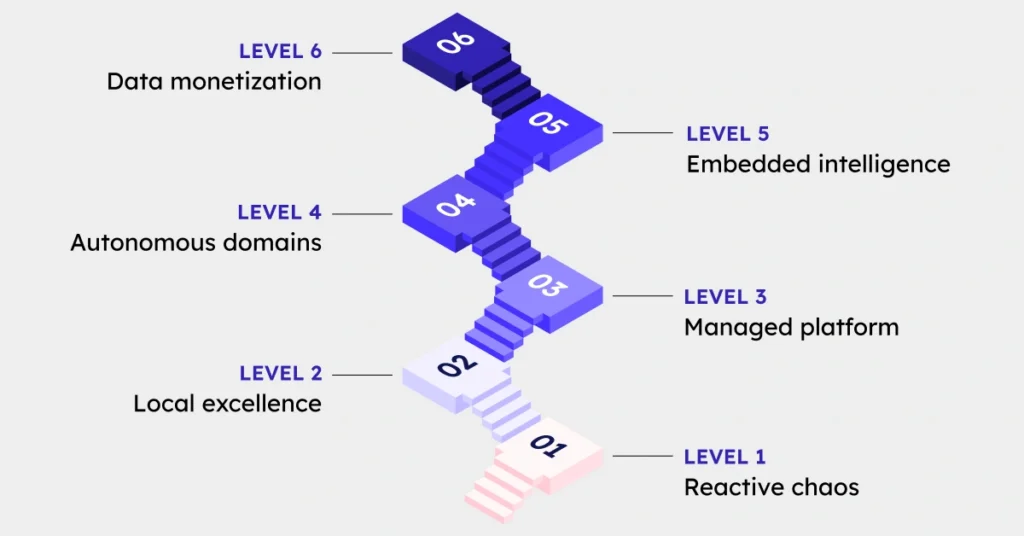
Level 1: Reactive chaos
This level describes organizations that do not manage data consciously, where data is a byproduct of processes and is scattered across Excel files and emails. Financing decisions are based on intuition, and asset valuations are done “by feel.” Scaling this kind of company is impossible, and regulatory risk, such as GDPR, is very high.
When IT spends time manually moving through systems and cleaning up data just to answer a question about contracts ending in the quarter, it is a sign that the company is at this level.
Level 2: Local excellence
At this stage, “local heroes” appear in individual departments. They organize work on their own, for example by creating sales dashboards or collections reports. Although there is more order within teams, the organization as a whole struggles with silos and the lack of a shared data vision.
A clear signal of this stage is a management board meeting where the sales department presents record results from its own spreadsheet, while the risk department simultaneously warns about declining profitability of the same contracts. Yet no one can explain the source of the discrepancy.
Level 3: Managed platform
This is the breakthrough moment: the company builds a central data warehouse used by everyone. The data is trusted and reliable. When the number of overdue installments suddenly increases, analysts can immediately point to the specific cause.
Key practices at this level include introducing shared business definitions and appointing data owners and data stewards. The organization ensures quality control and tracks data origin through data lineage, making it possible to finally see a complete 360-degree view of the customer, their contracts, and leased assets in one place.
A company reaches this level when morning reports are generated automatically from a single source of truth, and no one in the organization wastes time questioning their reliability.
Level 4: Autonomous domains
This is the stage where the organization stops only analyzing the past and starts actively designing tomorrow. Responsibility for data and insights moves into the business. Thanks to self-service tools, teams can test hypotheses and draw conclusions in real time. They no longer need to involve developers for every new question about the portfolio or the market.
An example of reaching this level is a product manager who can find the reason for a margin drop in a given region within minutes, using ready-made data sets, instead of submitting a report request to IT.
Level 5: Embedded intelligence
This is the stage where the organization can consciously “hand over the controls to the machine” in repeatable processes. Advanced analytics and AI models become the bloodstream of operations, often working in real time. Data becomes a physical element of the process, automating subsequent steps through machine learning. This requires modern event-driven architecture, where information flows instantly.
Here, technology starts to truly support people: scoring automatically moves safe applications forward, and the collections system triggers an alert for customers who may have payment issues before they even miss an installment.
Level 6: Data monetization
Finally, data becomes a strategic asset that enables new business models and helps the organization move beyond traditional financing. At this stage, leasing companies evolve from capital providers into real-time asset managers. This requires close cooperation with the entire ecosystem, including dealers, service providers, and insurers, as well as treating data as a high-quality finished product with defined parameters and SLAs.
The end point is a situation where data becomes a product, for example when a leasing company can suggest the ideal time for a fleet replacement offer to dealers based on how the customer actually uses their machines.
Do you need to move through all levels one by one?
Not always. Maturity rarely develops in a perfectly linear way. An organization may be stronger in one area and weaker in another, for example, it may have a mature data culture while still developing its data platform or analytics capabilities.
This is visible in AI. Companies can start experimenting with AI earlier, but to implement solutions the business can trust in daily work, they need to meet the conditions of level 4.
Why is knowing your maturity level so important?
A maturity assessment is above all a tool for rational budget and resource planning.
It helps managers in a leasing company answer key questions:
- Can the infrastructure support plans related to AI implementation?
- Where does the effectiveness of local spreadsheets end, and where does the real need for a shared data model begin?
- Which initiatives have the greatest business potential, and which will be only costly experiments on unstructured data?
What a data maturity assessment gives you
A Data Maturity Model assessment helps organize the conversation between business, IT, analytics, and the management board. It provides a consistent view of the current situation: where the organization is today, which areas are ready for the next step, and which require cleanup.


