When does a feature roadmap start to weaken a bank’s mobile app?
You keep adding new capabilities. The app now lets customers do more than pay a bill — they can also purchase a subscription or use additional services. And yet the number of negative reviews, abandoned journeys, and customer service contacts keeps rising. In an era of neobanks, rapid product iteration, and AI models that can recognize customer behaviors, banks face a seemingly difficult choice: accelerate development or get the basics in order first. In this article, we show that the real issue is not choosing between growth and strengthening the fundamentals, but getting the sequence of actions right.

What to know:
- A bank’s mobile app does not lose effectiveness because it has too few features. It loses effectiveness when complexity gets in the way of customers completing essential tasks.
- A banking app roadmap should start with the customer’s jobs to be done, not with a list of features to ship.
- AI and behavioral analytics can help banks pinpoint where app development improves the customer experience — and where it merely adds to the cost of complexity.
The paradox of a richer app
From the organization’s perspective, the app is evolving: new modules, shortcuts, screens, and integrations are being added. Each of these decisions has a business rationale — it responds to a market need, a sales objective, a regulatory requirement, or competitive pressure.
From the customer’s perspective, however, the same development can mean more effort: more options to distinguish, more steps to complete, and more places where customers need to figure out what to do next.
As a result, the app has more capabilities, but it does a weaker job of supporting the tasks customers open it for most often: checking their financial position, making a payment, finding information, or solving a simple problem.
This is not just a UX issue. Over time, it translates into higher service costs, lower engagement, and weaker performance across key journeys — provided the bank knows where to look for these signals in the data.
The fundamentals of a bank’s mobile app
When we talk about app fundamentals, it is easy to think first about architecture, performance, integrations, and security. These are important areas, but from the customer’s perspective, they do not tell the whole story.
For users, the fundamentals are primarily about whether the app helps them complete a task efficiently, without guessing, going back, or looking for help in another channel.
In practice, this includes:
- information architecture — whether customers can quickly find what they are looking for;
- navigation logic — whether journeys are predictable and consistent;
- labels and statuses — whether messages mean the same thing across different parts of the app;
- returning to an interrupted process — whether customers can continue a task without starting over;
- home screen priorities — whether the most important information and actions are available without additional effort.
Weakness in any of these areas lowers the quality of the customer experience. Each additional feature then increases the cost of maintaining the product and makes further app development harder.
Five signs complexity is starting to hurt the app
Weak fundamentals do not always require a full UX audit to identify. They often show up in operational data the bank already has, but does not always analyze through the lens of customer experience quality.
- The number of support contacts in core journeys is increasing. Customers call or write because the app does not guide them clearly enough.
- Users repeat actions. The system does not give them a clear confirmation that an action has been completed, so they try again or look for confirmation in another channel.
- The time required to complete key tasks is increasing quarter over quarter. Even without major interface changes, users need more time to complete the same actions.
- Onboarding is becoming less effective. New users drop off in the first few days, before the app becomes their natural channel for interacting with the bank.
- New features have low adoption. Not always because they miss the mark. Often, they get lost in the app’s structure or are not embedded in the journeys where customers actually need them.
When several of these signals appear at the same time, another feature is unlikely to solve the core problem. A more reliable first step is to identify where customers are losing their sense of direction, their time, or their confidence about what to do next.


The hidden cost of new features
Every new feature lands in an app structure that already exists: navigation, information architecture, interface language, and screen priorities. It is not just a separate roadmap item. It immediately starts to create an ongoing maintenance cost.
That cost includes, among other things:
- maintaining analytics and accurate events;
- regression testing in subsequent sprints;
- handling user inquiries and updating documentation;
- localization, especially when expanding into additional markets;
- consistency of language, messages, and statuses across the entire product.
In a well-structured app, this cost remains under control. In a product built on weaker foundations, it starts to accumulate: it slows the delivery of changes, puts pressure on teams, and gradually weakens the customer experience.
AI and behavioral analytics help detect friction
LLMs and behavioral analytics now make it easier to connect signals that were previously analyzed separately: user behavior in the app, process events, support contacts, app store reviews, and validation errors.
This helps the bank see more clearly which journeys actually support the customer and which ones create additional effort. AI can help identify patterns: recurring abandonment points, unclear messages, features with low adoption, or processes that end with a call to the contact center.
The scale of the problem in market data
Data from industry reports shows that friction in the mobile experience is not a problem limited to individual apps.
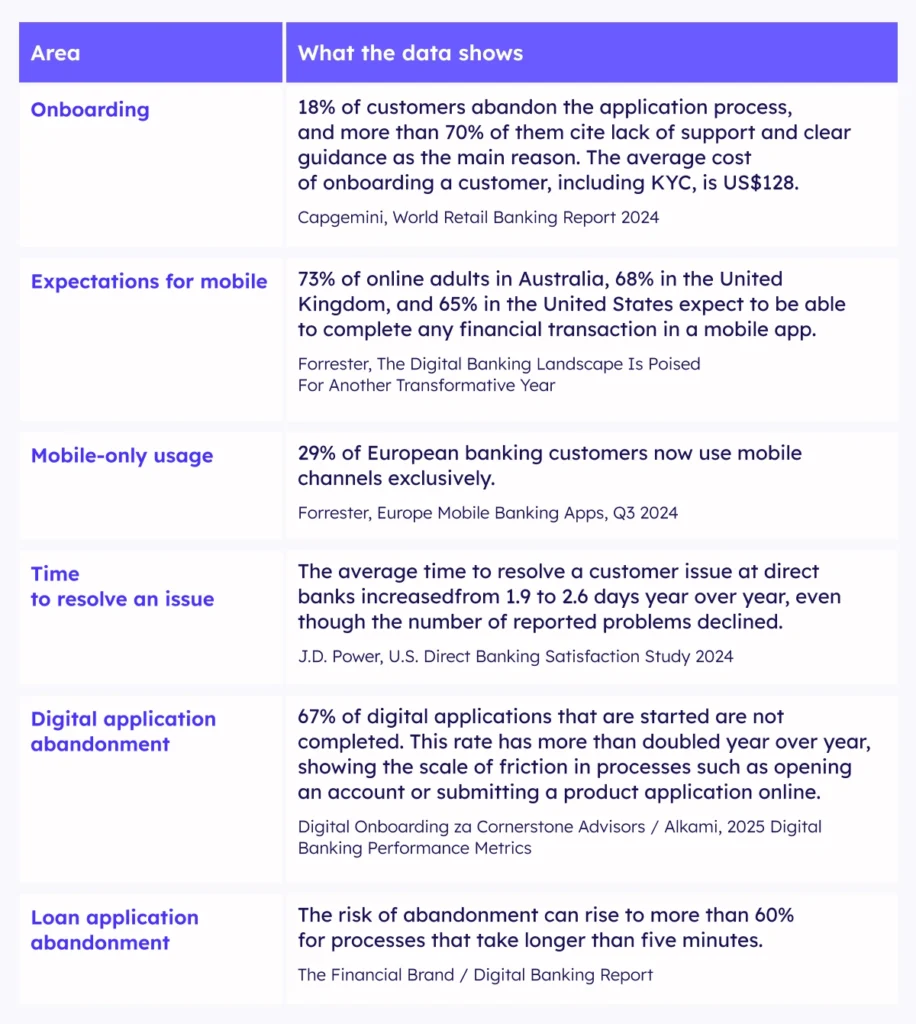
The shared conclusion is straightforward: when the mobile experience creates friction, customers do not always report the problem. Often, they abandon the process, return to support, or choose another channel. The bank sees it only later — in higher service costs, weaker feature adoption, and lower performance across key journeys.
What to check before the next release
Before approving another feature on the roadmap, it is worth running a quick operational check. It does not replace a full UX audit or architecture review, but it helps determine whether the app still supports the customer’s core tasks effectively.
The three-journey test
Walk through three key journeys — for example, checking a balance, making a transfer, and managing a card — exactly as a customer would. Count not only the clicks, but also the moments of hesitation: the places where users have to go back, look for confirmation, or switch channels. Each of these moments carries a cost that another module usually will not remove.
Five questions for the CPO / CDO
- Can customers complete their three most common tasks quickly and without hesitation?
- Are statuses, messages, and confirmations clear and consistent across the entire app?
- Does the new feature have a natural place in the navigation, without disrupting product consistency?
- Can customers return to an interrupted process without losing data or context?
- Have the most recent releases achieved the expected adoption within the first 60 days?
When the answer is “no” more than once, another feature is unlikely to solve the core problem. A safer next step is to first clean up the journeys, messages, data, and points where customers lose confidence about what to do next.

Metrics worth monitoring continuously
A one-time journey review is not enough. If the app is going to evolve without adding unnecessary complexity, the bank should continuously monitor several metrics related to experience quality and product effectiveness:
- Median task time for the three key journeys. Measured quarterly, it helps determine whether core tasks are becoming slower even without major interface changes.
- Drop-off rate in core flows. This is worth monitoring across onboarding, product applications, transfers, card management, and other processes that have a direct impact on self-service.
- Percentage of sessions with repeated actions. This is especially important where users may not be sure whether an action was completed successfully.
- Ticket volume related to core features vs. new releases. This helps determine whether product development is actually reducing friction or simply moving it into customer support.
- Feature adoption rate after 30 and 60 days. This shows whether a new feature is actually being used after release and whether it supports the customer’s task at a natural point in the journey.
These metrics help distinguish an app that is truly evolving from one that is simply increasing the number of available options.
Conclusion
Mature mobile banking is not about adding more and more features. It is about making the app clear, predictable, and effective for the tasks customers perform most often.
AI will accelerate the development of new solutions, but it will not eliminate the cost of complexity. If the foundations are weak, problems will also grow faster across UX, data, architecture, customer support, and maintenance.
That is why the advantage will go to banks that know how to evolve their apps in the right sequence: first, by cleaning up journeys and fundamentals, and only then by scaling additional features.